The Pregnancy Conception Calculator helps estimate the likely date of conception using information such as the expected due date, the first day of the last menstrual period, or ultrasound results. It identifies the approximate day when fertilization occurred and provides a possible range of dates when conception may have taken place, taking into account that sperm can remain viable in the female reproductive system for 3–5 days.
Pregnancy Conception Calculator
The Pregnancy Conception Calculator estimates the date of conception based on the expected due date, last period, or ultrasound date.
Pregnancy Conception Calculator: How to Calculate Conception Date Accurately
Understanding when conception occurred is one of the most common questions during pregnancy. Many women ask, “When did I conceive?” or “Which days likely led to pregnancy?” A Pregnancy Conception Calculator helps estimate the most probable and possible dates of conception using medically accepted reference points such as the due date, last menstrual period (LMP), and ultrasound measurements.
This article explains in detail how a pregnancy conception calculator works, the science behind fertilization and conception, and how each calculation method provides accurate estimates.
What Is a Pregnancy Conception Calculator?
A pregnancy conception calculator is an online medical tool designed to estimate the time window when fertilization likely occurred. Since exact conception timing is difficult to determine naturally, the calculator uses biological averages and clinical data to generate:
- Most probable conception dates
- Possible conception date range
- Most probable dates of sexual intercourse leading to pregnancy
- Possible intercourse date range
These estimates are widely used by healthcare professionals and pregnancy tracking platforms.
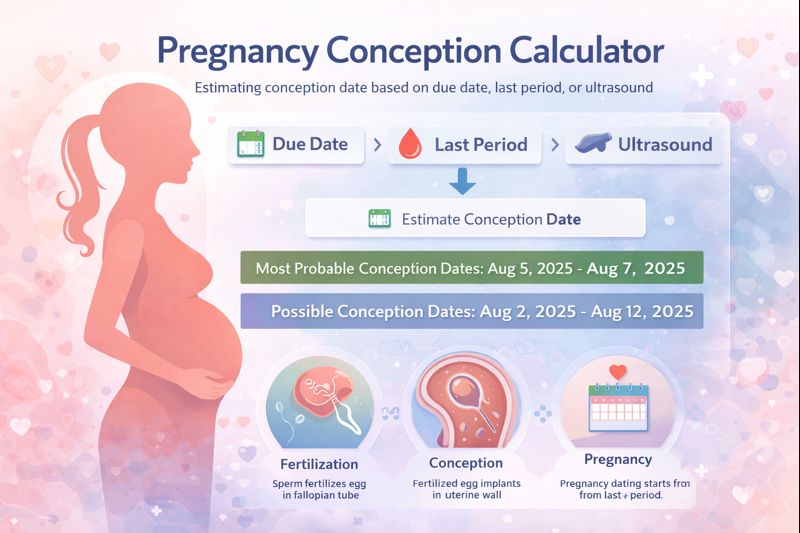
Fertilization, Conception, and Pregnancy: Key Differences Explained
Before understanding the calculator, it is essential to clarify three closely related but different terms.
Fertilization
Fertilization is the biological process where a sperm penetrates and merges with an egg (ovum), usually in the fallopian tube. This typically occurs within 12–24 hours after ovulation.
- Sperm can survive up to 5 days in the female reproductive tract.
- The egg remains viable for about 24 hours after ovulation.
Conception
Conception refers to the moment when the fertilized egg successfully implants into the uterine wall. Implantation usually occurs 6–10 days after fertilization.
This distinction explains why calculators estimate a range rather than an exact day.
Pregnancy
Pregnancy is medically defined as beginning from the first day of the last menstrual period (LMP), not from fertilization. This convention allows doctors to standardize pregnancy dating, even though conception occurs later.
How the Pregnancy Conception Calculator Works
The calculator estimates conception by working backward or forward using scientifically accepted pregnancy timelines. It adjusts ranges based on sperm lifespan, ovulation timing, and fetal development rates.
Key Assumptions Used in Calculations
- Average pregnancy length: 280 days (40 weeks) from LMP
- Average time from conception to birth: 266 days
- Ovulation typically occurs 14 days before the next period
- Sperm viability: 3–5 days
- Egg viability: 24 hours
Calculate Conception Based on Due Date
How This Method Works
When a due date is known, the calculator subtracts 266 days to estimate the conception date.
Formula used:
Conception Date = Due Date − 266 days
Why This Method Is Reliable
- Due dates are often confirmed by ultrasound
- Provides strong accuracy in later pregnancy
- Commonly used by obstetricians
Limitations
- Due dates are still estimates
- Natural variation in gestation length exists
Calculate Conception Based on Last Menstrual Period (LMP)
How LMP Calculator Works
The calculator estimates ovulation using the average cycle length and then adds or subtracts days accordingly.
Formula used:
Ovulation Day = Cycle Length − 14
Conception ≈ Ovulation Day
Example
LMP: October 30
Cycle length: 28 days
Estimated ovulation: Day 14
Conception likely occurred around November 12–14
Advantages
Useful early in pregnancy
Works well for regular cycles
Commonly used worldwide
Limitations
Less accurate for irregular cycles
Ovulation may vary month to month
Calculate Conception Based on Ultrasound
Why Ultrasound Is Highly Accurate
Ultrasound measures fetal growth to estimate gestational age. Early ultrasounds (before 12 weeks) are especially precise.
How the Calculator Uses Ultrasound Data
The calculator subtracts the known gestational age from the ultrasound date and then adjusts for ovulation timing.
Formula used:
Conception Date = Ultrasound Date − (Weeks × 7 + Days) + 14 daysAdvantages
Most accurate method
Ideal for irregular cycles
Used by medical professionals
Limitations
Accuracy slightly decreases later in pregnancy
Depends on precise fetal measurements
Understanding the Conception Date Ranges
Because conception cannot be pinpointed to a single day, the calculator provides ranges.
Most Probable Conception Dates
This is the narrowest window, usually ±2 days, based on ovulation timing.
Possible Conception Dates
This broader range accounts for:
- Sperm survival
- Delayed ovulation
- Implantation variability
Most Probable Intercourse Dates
This range reflects days when intercourse most likely led to pregnancy, often spanning 5–7 days before ovulation.
Possible Intercourse Dates
This expanded range includes biological outliers and delayed fertilization scenarios.
Medical Accuracy and Research Basis
Pregnancy conception calculators are based on guidelines from:
- American College of Obstetricians and Gynecologists (ACOG)
- World Health Organization (WHO)
- Peer-reviewed obstetrics research
- Clinical ultrasound standards
These methods are routinely used in prenatal care worldwide.
Who Should Use a Pregnancy Conception Calculator?
- Women planning pregnancy
- Expectant mothers curious about conception timing
- Couples tracking fertility
- Healthcare professionals
- Researchers and educators
Frequently Asked Questions
Can a calculator tell the exact day of conception?
No. It provides a medically accurate date range, not a guaranteed single day.
Is ultrasound better than LMP?
Yes. Early ultrasound is the most accurate dating method.
Does cycle length affect conception calculations?
Yes. Longer or shorter cycles shift ovulation timing.
Popular Calculator Tools
- Period Calculator
- Loan Calculator
- Ovulation Calculator
- Home Equity Line of Credit (HELOC) Calculator
- Blood Pressure Calculator
- Pregnancy Calculator
- Conception Calculator
- Due Date Calculator
- Pregnancy Weight Gain Calculator
- Total Daily Energy Expenditure (TDEE) Calculator
- Fat Intake Calculator
- Interest Rate Calculator
- Annuity Calculator
- Annuity Payout Calculator
- ROI Calculator
- Sales Tax Calculator
- VAT Calculator
- BMI Calculator
- Calorie Calculator
- Body Fat Calculator
- BMR Calculator
- Ideal Weight Calculator
- Lean Body Mass Calculator
- Percentage Calculator
- Area Calculator
- GPA Calculator
- CGPA Calculator
- Age Calculator
- Zakat Calculator