
eGFR Calculator
Chronic Kidney Disease (CKD) Stages
| Stage | GFR Value (mL/min/1.73 m²) |
|---|---|
| Normal | 90+ or above and no proteinuria |
| CKD 1 | 90+ with evidence of kidney damage |
| CKD 2 (Mild) | 60 to 89 with evidence of kidney damage |
| CKD 3 (Moderate) | 30 to 59 |
| CKD 4 (Severe) | 15 to 29 |
| CKD 5 (Kidney Failure) | Less than 15 |
eGFR Calculator: Accurate Kidney Function Assessment Explained
An eGFR calculator is one of the most widely used clinical tools for assessing kidney function and detecting chronic kidney disease (CKD) at an early stage. Estimated glomerular filtration rate (eGFR) provides a numerical value that reflects how efficiently the kidneys are filtering waste products from the blood. Because kidney disease often progresses silently, eGFR calculation plays a crucial role in preventive medicine, nephrology, internal medicine, and primary care.
This article explains what eGFR is, how to calculate eGFR, the eGFR calculation formula, and how eGFR values are used to diagnose and classify chronic kidney disease and its stages.
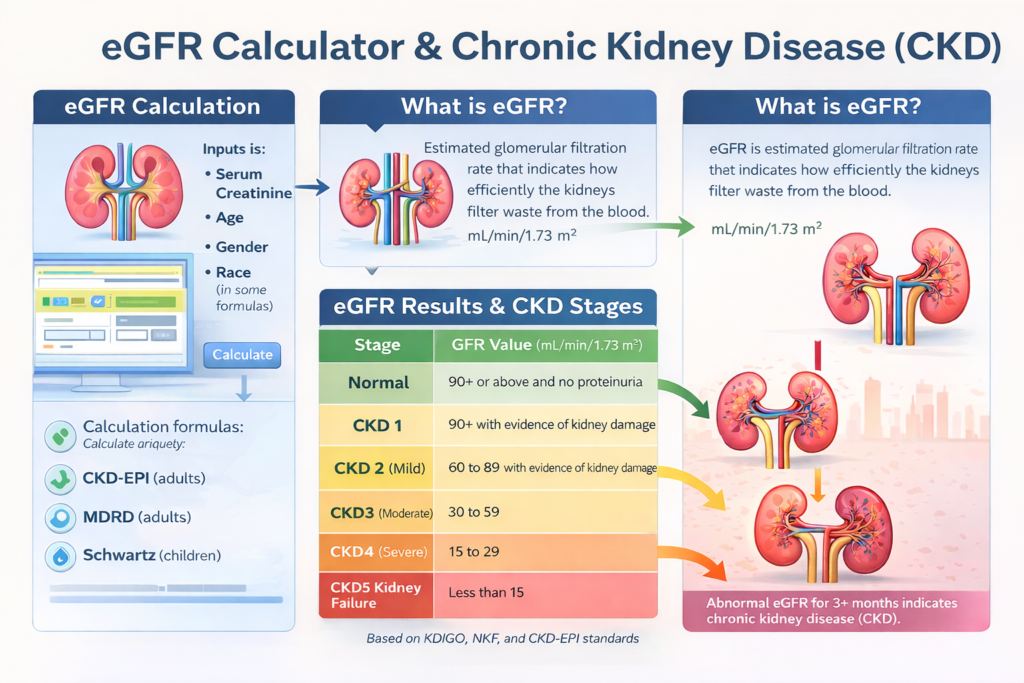
What Is eGFR?
Estimated glomerular filtration rate (eGFR) is a calculated value that estimates the volume of blood filtered by the glomeruli of the kidneys per minute, normalized to a standard body surface area of 1.73 m². It is expressed as:
mL/min/1.73 m²
The glomeruli are microscopic filtration units within the kidneys that remove waste products, excess electrolytes, and fluid from the bloodstream. A decline in glomerular filtration rate reflects impaired kidney function.
Unlike measured GFR, which requires complex tests using substances such as inulin or radioisotopes, eGFR calculation relies on serum creatinine, a routinely available laboratory value, combined with demographic factors such as age, sex, and race.
Why Is an eGFR Calculator Important?
An eGFR calculator is essential because:
- Kidney disease often has no symptoms in early stages
- Serum creatinine alone can be misleading
- eGFR adjusts for age, sex, and muscle mass
- It enables early detection of CKD
- It guides drug dosing, imaging contrast use, and referral to nephrology
Clinicians rely on eGFR calculation to determine whether kidney function is normal, mildly reduced, or severely impaired.
Understanding Serum Creatinine and eGFR
Serum creatinine is a waste product derived from muscle metabolism. Healthy kidneys filter creatinine efficiently. When kidney function declines, creatinine accumulates in the blood.
However, serum creatinine levels are influenced by:
- Age
- Sex
- Muscle mass
- Diet
- Ethnicity
This is why eGFR calculation formulas were developed—to provide a more accurate estimation of kidney function than creatinine alone.
How to Calculate eGFR using eGFR calculator
Step-by-Step Overview
To understand how to calculate eGFR, the following inputs are typically required:
- Serum creatinine (mg/dL or µmol/L)
- Age (years)
- Sex (male or female)
- Race (in older formulas)
- Height (for pediatric patients)
These values are entered into an eGFR calculator, which applies a validated mathematical formula to estimate kidney filtration capacity.
Common eGFR Calculation Formulas
Multiple eGFR calculation formulas are used in clinical practice. Each has specific indications and limitations.
1. CKD-EPI eGFR Calculation Formula
The CKD-EPI (Chronic Kidney Disease Epidemiology Collaboration) equation is the most widely recommended formula for adults.
It provides better accuracy than older formulas, especially at higher GFR levels.
General form (simplified):
- Uses serum creatinine
- Adjusts for age and sex
- Includes race factor in older versions
- Outputs eGFR in mL/min/1.73 m²
CKD-EPI is preferred for:
- CKD diagnosis
- Risk stratification
- Long-term monitoring
2. MDRD eGFR Calculation Formula
The Modification of Diet in Renal Disease (MDRD) equation was widely used before CKD-EPI.
Characteristics:
- Accurate in moderate to severe CKD
- Underestimates GFR in healthy individuals
- Still used in many labs
MDRD is useful when:
- eGFR is below 60 mL/min/1.73 m²
- Monitoring advanced CKD
3. Mayo Quadratic Formula
The Mayo Clinic quadratic equation improves accuracy in individuals with near-normal kidney function.
It is less commonly reported by laboratories but is useful in research and clinical interpretation when creatinine levels are low.
4. Schwartz Formula for Children
In pediatric patients, kidney function correlates more closely with body size than age.
The Schwartz eGFR calculation formula is used for children and adolescents:
- Requires height
- Uses a pediatric-specific constant
- Adjusted for growth and development
eGFR Calculator Units Explained
All eGFR calculators report results as:
mL/min/1.73 m²
This standardized unit allows comparison across individuals of different body sizes. It does not represent the patient’s actual body surface area but a normalized value used universally in nephrology.
What Is Chronic Kidney Disease (CKD)?
Chronic kidney disease (CKD) is defined as abnormalities of kidney structure or function present for more than three months, with implications for health.
Diagnosis is based on:
- Reduced eGFR
- Evidence of kidney damage (e.g., proteinuria, structural abnormalities)
An eGFR calculator is central to CKD diagnosis and staging.
CKD Stages Based on eGFR
Chronic kidney disease is classified into stages based on eGFR values.
CKD Classification by eGFR
| Stage | eGFR (mL/min/1.73 m²) | Description |
|---|---|---|
| Normal | ≥90 | Normal kidney function, no damage |
| CKD Stage 1 | ≥90 | Kidney damage with normal eGFR |
| CKD Stage 2 | 60–89 | Mild decrease in kidney function |
| CKD Stage 3 | 30–59 | Moderate kidney damage |
| CKD Stage 4 | 15–29 | Severe kidney damage |
| CKD Stage 5 | <15 | Kidney failure |
CKD Stage 1: Normal eGFR With Kidney Damage
In CKD Stage 1:
- eGFR is normal or high
- Evidence of kidney damage exists
- Common findings include proteinuria or abnormal imaging
An eGFR calculator alone cannot diagnose CKD Stage 1 without additional clinical evidence.
CKD Stage 2: Mild Reduction in Kidney Function
CKD Stage 2 involves:
- Slightly reduced eGFR
- Often asymptomatic
- Early intervention can slow progression
Routine eGFR calculation helps identify at-risk individuals.
CKD Stage 3: Moderate Kidney Disease
Stage 3 CKD is clinically significant and often subdivided:
- Stage 3a: eGFR 45–59
- Stage 3b: eGFR 30–44
Patients may begin to develop:
- Anemia
- Bone mineral disorders
- Hypertension
At this stage, regular eGFR monitoring is essential.
CKD Stage 4: Severe Kidney Disease
CKD Stage 4 indicates advanced kidney damage.
Clinical features include:
- Fatigue
- Fluid retention
- Electrolyte imbalance
Preparation for renal replacement therapy often begins at this stage.
CKD Stage 5: Kidney Failure
CKD Stage 5 is defined by:
- eGFR less than 15 mL/min/1.73 m²
- End-stage renal disease (ESRD)
Patients may require:
- Dialysis
- Kidney transplantation
eGFR calculation guides the timing of these interventions.
Factors That Affect eGFR Accuracy
While an eGFR calculator is highly useful, results may be less accurate in:
- Extreme muscle mass (bodybuilders, amputees)
- Pregnancy
- Acute kidney injury
- Severe malnutrition
- Rapidly changing creatinine levels
Clinical judgment is always required.
How Often Should eGFR Be Checked?
Frequency depends on risk level:
- Healthy adults: periodically
- Diabetes or hypertension: at least annually
- Established CKD: every 3–6 months or more frequently
Regular eGFR calculation allows early detection of progression.
eGFR Calculator vs Measured GFR
| Feature | eGFR Calculator | Measured GFR |
|---|---|---|
| Cost | Low | High |
| Convenience | High | Low |
| Accuracy | High for most | Gold standard |
| Clinical use | Routine | Specialized |
eGFR remains the preferred tool in everyday practice.
Conclusion
An eGFR calculator is a cornerstone of modern kidney care. Understanding how to calculate eGFR, the eGFR calculation formula, and the clinical meaning of eGFR values empowers both clinicians and patients to detect kidney disease early, classify CKD accurately, and guide timely interventions.
While no calculation replaces clinical judgment, eGFR calculation provides a reliable, standardized, and evidence-based method for assessing renal function. Used correctly, it can significantly improve outcomes for individuals at risk of chronic kidney disease.
References
Eknoyan, G., Lameire, N., Eckardt, K., Kasiske, B., Wheeler, D., Levin, A., et al. (2013). KDIGO 2012 Clinical Practice Guideline for the Evaluation and Management of Chronic Kidney Disease. Kidney International Supplements.
Popular Calculator Tools
- BSA Calculator
- Period Calculator
- Ovulation Calculator
- Blood Pressure Calculator
- Pregnancy Calculator
- Conception Calculator
- Due Date Calculator
- Pregnancy Weight Gain Calculator
- Pregnancy Conception Calculator
- Total Daily Energy Expenditure (TDEE) Calculator
- Blood Alcohol Concentration (BAC) Calculator
- Corrected Calcium Calculator
- Anion Gap Calculator
- BMI Calculator
- Calorie Calculator
- Body Fat Calculator
- BMR Calculator
- Ideal Weight Calculator
- Lean Body Mass Calculator