
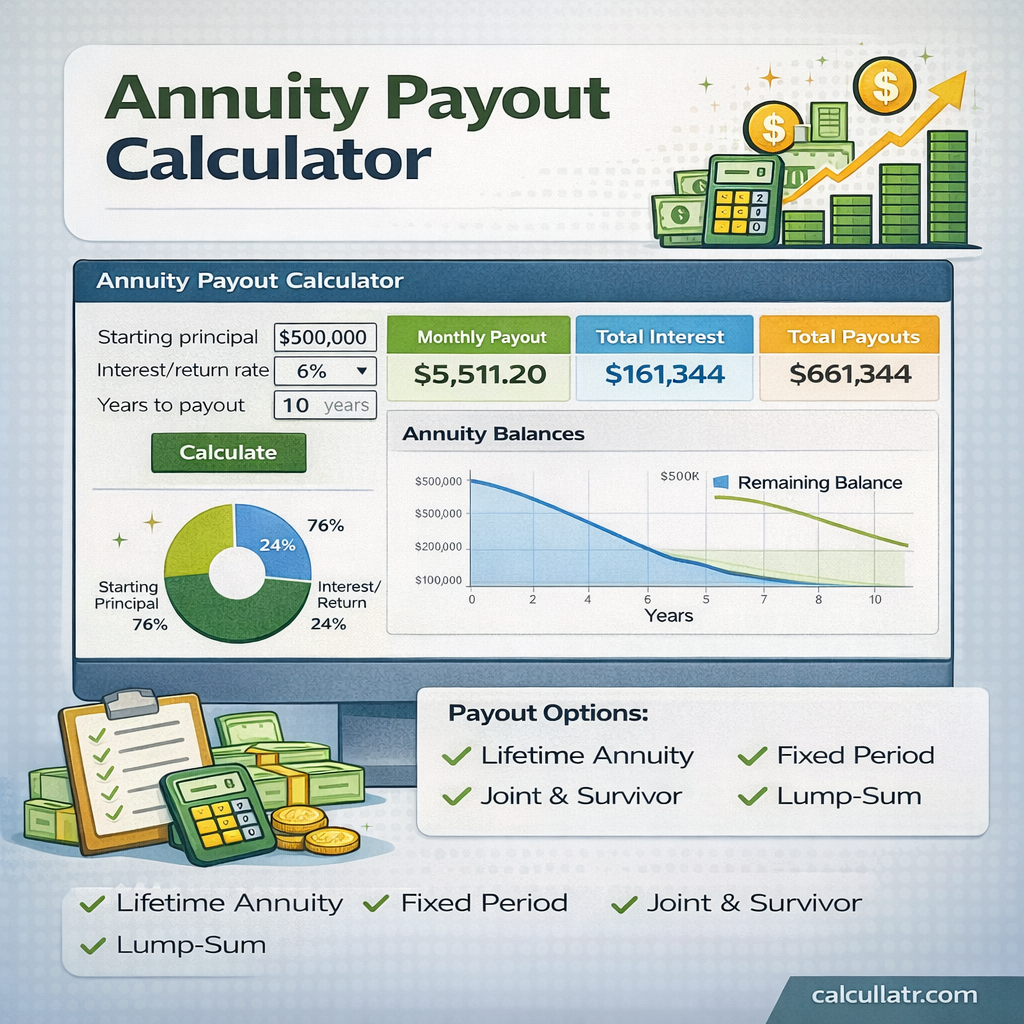
Annuity Payout Calculator
Results
Payout Amount
–
–
Total Interest
–
–
Total Payouts
–
–
Annuity Balances
| Year | Beginning Balance | Interest | Ending Balance |
|---|
Annuity Payout Calculator: How Annuity Payments Work, Payout Options, and Tax Treatment Explained
An annuity payout calculator helps estimate how much income you can receive from an annuity during retirement. Whether you’re planning guaranteed lifetime income or fixed withdrawals over a set period, understanding annuity payouts is essential for effective retirement planning.
This guide explains how annuity payouts work, qualified vs non-qualified annuities, annuity phases, payout options, tax implications, and how to use an annuity payout calculator accurately.
What Is an Annuity Payout?
An annuity payout is the stream of income you receive from an annuity contract after the accumulation phase ends. During this phase, the insurance company converts your annuity balance into regular payments based on factors such as:
- Account value
- Interest or return rate
- Payout duration
- Payout frequency (monthly, quarterly, yearly)
- Life expectancy (for lifetime payouts)
An annuity payout calculator estimates this income so you can plan your retirement more confidently
How an Annuity Payout Calculator Works
An annuity payout calculator determines your periodic withdrawal amount using:
Starting principal (annuity value)
Interest or return rate
Payout period
Payment frequency
The calculator applies financial formulas similar to loan amortization but in reverse—gradually reducing your balance while factoring in earned interest.
Key Benefits of Using an Annuity Payout Calculator
- Estimates monthly or yearly retirement income
- Compares different payout options
- Helps avoid running out of money
- Supports long-term financial planning
Phases of an Annuity
Annuities have two main phases, and understanding them is crucial before selecting payout options.
Accumulation Phase
The accumulation phase is when you fund the annuity. During this period:
- You make lump-sum or periodic contributions
- Your money grows tax-deferred
- Interest or market returns accumulate
This phase may last several years or decades
Payout (Annuitization) Phase
The payout phase begins when you start receiving income from the annuity. At this stage:
- Contributions stop
- Regular withdrawals begin
- Your balance declines over time (unless indexed or variable)
An annuity payout calculator is used only during this phase.
Qualified vs Non-Qualified Annuities
One of the most searched annuity topics is the difference between qualified and non-qualified annuities, especially for tax planning.
Qualified Annuities
Qualified annuities are funded using pre-tax dollars from tax-advantaged retirement accounts such as:
401(k)
403(b)
Traditional IRA
Tax Treatment
Entire payout is taxable as ordinary income
Subject to Required Minimum Distributions (RMDs) after age 73 (USA)
Best For
Employer-sponsored retirement plans
Individuals seeking tax-deferred retirement growth
Non-Qualified Annuities
Non-qualified annuities are funded using after-tax dollars.
Tax Treatment
Only the earnings portion of payouts is taxable
Principal is returned tax-free
Not subject to RMD rules
Best For
Individuals who have maxed out retirement accounts
Supplemental retirement income
Annuity Payout Options Explained
Choosing the right payout option is critical, as many annuity decisions are irrevocable.
1. Lifetime Annuity (Life-Only)
Pays income for as long as you live.
Pros
Guaranteed lifetime income
No longevity risk
Cons
Payments stop at death
No inheritance
2. Life with Period Certain
Pays income for life, but guarantees payments for a minimum period (e.g., 10 or 20 years).
Pros
Protects beneficiaries
Lifetime security
Cons
Slightly lower payments than life-only
3. Fixed Period Annuity
Pays income for a specific number of years.
Pros
Predictable income
Higher periodic payouts
Cons
Risk of outliving the income stream
4. Joint and Survivor Annuity
Covers two individuals, usually spouses.
Pros
Income continues for surviving spouse
Cons
Lower payout amounts
5. Lump-Sum Payout
Withdraws the entire balance at once.
Pros
Full liquidity
Investment flexibility
Cons
Large tax burden
Loss of guaranteed income
Annuity Payout Frequency Options
Most annuity payout calculators allow you to choose payout frequency:
Monthly (most common)
Quarterly
Semi-annually
Annually
More frequent payouts typically result in slightly lower per-payment amounts.
Taxation of Annuity Payouts
Ordinary Income Tax
Earnings are taxed as regular income
No capital gains rates apply
Early Withdrawal Penalty
Withdrawals before age 59½ may incur a 10% IRS penalty (USA)
Exclusion Ratio (Non-Qualified Annuities)
Determines how much of each payment is taxable vs tax-free.
Factors That Affect Annuity Payout Amounts
- Age at annuitization
- Interest rate environment
- Account balance
- Payout duration
- Inflation protection
- Fees and riders
Fixed vs Variable vs Indexed Annuity Payouts
Fixed Annuity Payouts
Guaranteed payments
Predictable income
Variable Annuity Payouts
Payments fluctuate with market performance
Higher risk, higher potential return
Indexed Annuity Payouts
Linked to market indexes
Downside protection with capped growth
Why Use an Online Annuity Payout Calculator?
Using an online annuity payout calculator helps you:
Compare payout strategies
Plan retirement income streams
Avoid costly annuity mistakes
Make data-driven decisions
It eliminates guesswork and shows clear financial projections.
- Choosing irreversible payout options too early
- Ignoring inflation
- Underestimating taxes
- Not comparing payout structures
- Failing to include beneficiaries
Final Thoughts
An annuity payout calculator is one of the most powerful retirement planning tools available. By understanding qualified vs non-qualified annuities, annuity phases, and payout options, you can maximize income while minimizing risk.
Before selecting an annuity payout structure, use a calculator, evaluate tax implications, and consider long-term retirement goals.
Popular Calculator Tools
- Interest Rate Calculator
- Annuity Calculator
- Period Calculator
- Loan Calculator
- Ovulation Calculator
- Home Equity Line of Credit (HELOC) Calculator
- Blood Pressure Calculator
- Pregnancy Calculator
- Conception Calculator
- Due Date Calculator
- Pregnancy Weight Gain Calculator
- Pregnancy Conception Calculator
- Total Daily Energy Expenditure (TDEE) Calculator
- Fat Intake Calculator
- ROI Calculator
- Sales Tax Calculator
- VAT Calculator
- BMI Calculator
- Calorie Calculator
- Body Fat Calculator
- BMR Calculator
- Ideal Weight Calculator
- Lean Body Mass Calculator
- Percentage Calculator
- Area Calculator
- GPA Calculator
- CGPA Calculator
- Age Calculator
- Zakat Calculator