TDEE Calculator
TDEE Calculator: Complete Guide to Total Daily Energy Expenditure, BMR, Calories & Weight Management
Understanding your daily calorie needs is key to achieving your fitness goals, and a TDEE calculator for weight loss makes it simple. TDEE, or Total Daily Energy Expenditure, measures how many calories your body burns in a day based on your activity level, age, weight, and height. If you’re wondering how to calculate TDEE, our TDEE calculator weight loss tool does it automatically, giving you an accurate estimate of the calories you should consume to shed pounds safely. The best part? It’s completely TDEE calculator free, so you can track your daily intake without any cost. Using this calculator can help you plan meals, monitor your progress, and achieve weight loss results efficiently while staying healthy.
What Is TDEE (Total Daily Energy Expenditure)?
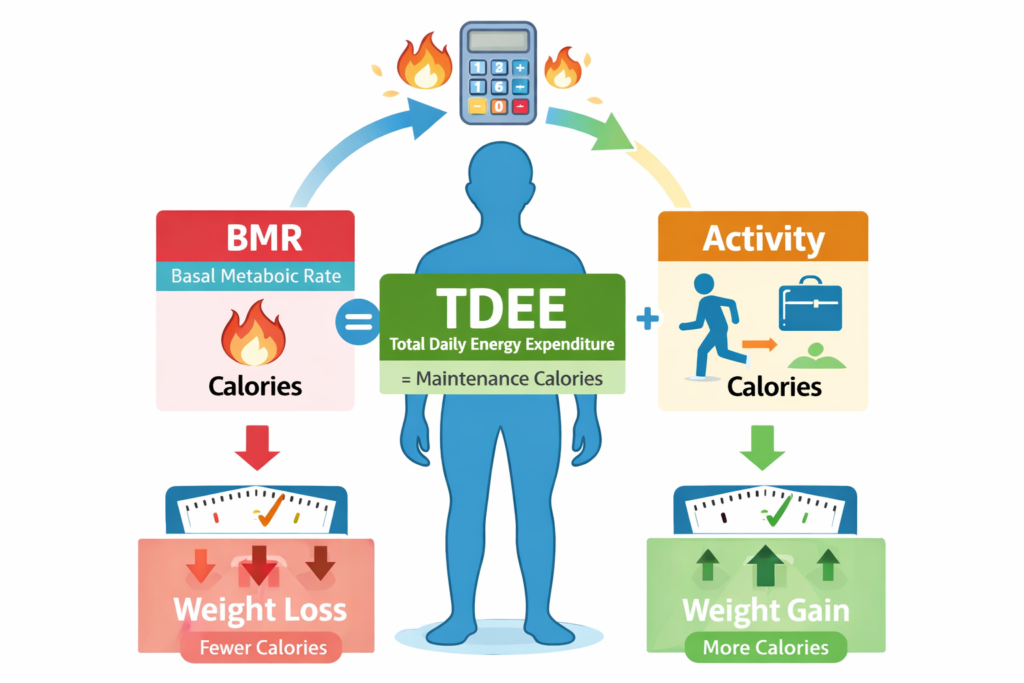
Total Daily Energy Expenditure (TDEE) is the total number of calories your body burns in a full day. This includes:
- Calories burned at rest
- Calories burned during physical activity
- Calories burned while digesting food
In simple terms:
TDEE = the total calories you need per day to maintain your current weight
If you eat:
- More than your TDEE → weight gain
- Less than your TDEE → weight loss
- Exactly your TDEE → weight maintenance
Why TDEE Is More Important Than Just Calories
Many people focus only on calorie counting, but without understanding TDEE, calorie intake becomes guesswork. TDEE helps you:
- Set accurate calorie targets
- Avoid extreme dieting
- Prevent muscle loss
- Improve athletic performance
- Maintain long-term metabolic health
Using a TDEE calculator eliminates assumptions and personalizes your calorie needs based on your body and lifestyle.
What Is BMR (Basal Metabolic Rate)?
Basal Metabolic Rate (BMR) is the number of calories your body burns at complete rest to keep vital functions running, such as:
- Breathing
- Blood circulation
- Brain function
- Body temperature regulation
Even if you stayed in bed all day, your body would still burn calories. That number is your BMR.
Difference Between BMR and TDEE
| Term | Meaning |
|---|---|
| BMR | Calories burned at rest |
| TDEE | Calories burned at rest + daily activities |
TDEE is always higher than BMR, because it includes movement, exercise, and digestion.
how to calculate tDEE?
A TDEE calculator works in two main steps:
Step 1: Calculate BMR
Using scientifically validated equations such as:
Mifflin-St Jeor Formula
Katch-McArdle Formula
Step 2: Apply Activity Multiplier
Your BMR is multiplied by an activity factor based on your lifestyle.
Formula:
TDEE = BMR × Activity Level
BMR Calculation Formulas Explained
1. Mifflin-St Jeor Equation (Most Common)
This is the most widely recommended formula for the general population.
For men:
BMR = (10 × weight in kg) + (6.25 × height in cm) − (5 × age) + 5
For women:
BMR = (10 × weight in kg) + (6.25 × height in cm) − (5 × age) − 161
✔ Accurate for most people
✔ Does not require body fat percentage
2. Katch-McArdle Formula (More Advanced)
This formula uses lean body mass, making it useful for athletes or people who know their body fat percentage.
BMR = 370 + (21.6 × Lean Body Mass in kg)
Lean Body Mass = Weight × (1 − Body Fat %)
✔ More precise for lean individuals
✔ Requires body fat percentage
Activity Levels in a TDEE Calculator
Activity level is what turns BMR into TDEE. Choosing the correct activity level is critical for accurate results.
| Activity Level | Multiplier | Description |
|---|---|---|
| Sedentary | 1.2 | Desk job, little or no exercise |
| Lightly Active | 1.375 | Light exercise 1–3 days/week |
| Moderately Active | 1.55 | Moderate exercise 3–5 days/week |
| Very Active | 1.725 | Hard exercise 6–7 days/week |
| Extra Active | 1.9 | Physical job or intense daily training |
What Does a TDEE Calculator Show?
A high-quality TDEE calculator (like the one above) provides:
1. Maintenance Calories
Calories needed to maintain your current weight.
2. Calories for Weight Loss
- Mild weight loss (≈ 0.25 kg/week)
- Moderate weight loss (≈ 0.5 kg/week)
- Extreme weight loss (≈ 1 kg/week)
3. Calories for Weight Gain
- Mild gain
- Moderate gain
- Fast gain (for bulking)
4. BMI (Body Mass Index)
Calculated using height and weight:
BMI = weight (kg) ÷ height² (m²)
BMI categories:
- Underweight: < 18.5
- Normal: 18.5–24.9
- Overweight: 25–29.9
- Obese: ≥ 30
tdee calculator for weight loss and weight gain
Calories for Weight Loss: How Much Deficit Is Safe?
| Goal | Calorie Deficit |
|---|---|
| Mild loss | −250 kcal/day |
| Moderate loss | −500 kcal/day |
| Aggressive loss | −1000 kcal/day |
Calories for Weight Gain: Lean vs Fat Gain
| Goal | Calorie Surplus |
|---|---|
| Mild gain | +250 kcal/day |
| Moderate gain | +500 kcal/day |
| Fast gain | +1000 kcal/day |
For lean muscle gain:
- Prefer 250–500 kcal surplus
- Combine with resistance training
- Maintain high protein intake
How Accurate Is a TDEE Calculator?
TDEE calculators are estimation tools, not medical diagnostics.
Accuracy depends on:
- Correct activity level selection
- Accurate height and weight
- Consistent lifestyle
Most calculators are accurate within ±5–10%, which is sufficient for real-world use.
A TDEE calculator is one of the most powerful tools for understanding your body’s energy needs. By combining accurate BMR formulas, realistic activity levels, and personalized calorie targets, it removes guesswork from nutrition planning.
Whether your goal is fat loss, muscle gain, or long-term health, using a TDEE calculator consistently—and adjusting based on progress—leads to sustainable results.
Popular Calculator Tools
- Period Calculator
- Loan Calculator
- Ovulation Calculator
- Home Equity Line of Credit (HELOC) Calculator
- Blood Pressure Calculator
- Pregnancy Calculator
- Conception Calculator
- Due Date Calculator
- Pregnancy Weight Gain Calculator
- Pregnancy Conception Calculator
- Fat Intake Calculator
- Interest Rate Calculator
- Annuity Calculator
- Annuity Payout Calculator
- ROI Calculator
- Sales Tax Calculator
- VAT Calculator
- BMI Calculator
- Calorie Calculator
- Body Fat Calculator
- BMR Calculator
- Ideal Weight Calculator
- Lean Body Mass Calculator
- Percentage Calculator
- Area Calculator
- GPA Calculator
- CGPA Calculator
- Age Calculator
- Zakat Calculator