
Due Date Calculator
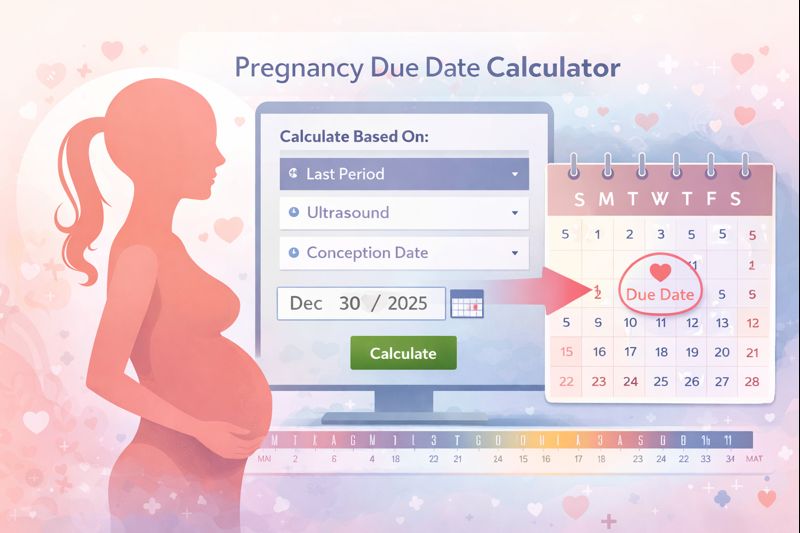
The Due Date Calculator estimates the delivery date of a pregnant woman based on her last menstrual period (LMP), ultrasound, conception date, or IVF transfer date.
Pregnancy Due Date Calculator: How to Calculate Your Due Date Accurately
A pregnancy due date calculator helps estimate when your baby is likely to be born. While only about 5% of babies arrive on their exact due date, calculating this date is essential for tracking fetal development, scheduling prenatal visits, planning maternity leave, and understanding pregnancy milestones.
This guide explains how a due date is calculated, the meaning of different calculation methods, how accurate due dates are, and what happens if your baby arrives early or late.
What Is a Pregnancy Due Date?
A due date (also called Estimated Date of Delivery – EDD) is the approximate date when a pregnant person is expected to give birth. It is usually calculated based on a 40-week (280-day) pregnancy, counting from the first day of the last menstrual period (LMP).
Doctors use the due date as a reference point, not a deadline. Normal delivery can occur anywhere between 37 and 42 weeks of pregnancy.
What Is a Due Date Calculator?
A due date calculator is an online medical tool that estimates your delivery date using one of several medically accepted reference points, such as:
- Last menstrual period (LMP)
- Ultrasound measurements
- Conception date
- IVF transfer date
These calculators are based on clinical obstetric guidelines and are widely used by gynecologists and maternity clinics.
Calculate Based On: Explanation of Each Method
1. Last Menstrual Period (LMP)
Most commonly used method
- Starts from the first day of your last period
- Assumes ovulation occurred around day 14
- Adds 280 days (40 weeks) to the LMP date
- Can be adjusted using average cycle length
Best for:
People with regular menstrual cycles
Limitations:
Less accurate if cycles are irregular or ovulation occurred early or late
2. Ultrasound Dating
Most accurate in early pregnancy
- Uses fetal measurements (crown-rump length)
- Requires gestational age in weeks and days
- Calculates remaining pregnancy duration
Best for:
- Irregular cycles
- Unknown LMP
- First-trimester confirmation
Accuracy:
Highest between 7–12 weeks of pregnancy
3. Conception Date
- Adds 266 days (38 weeks) from the known conception date
- Requires precise timing of ovulation or fertilization
Best for:
Those tracking ovulation or fertility treatments (non-IVF)
4. IVF Transfer Date
The IVF method in a pregnancy due date calculator is designed specifically for assisted conception, where timing is known with greater precision. An IVF due date calculator estimates delivery by using the exact embryo transfer date and the embryo’s age at transfer, making it more accurate than traditional LMP-based methods. When you calculate due date from IVF, the tool accounts for whether a 3-day, 5-day, or 7-day embryo was transferred, ensuring clinically reliable results. A due date calculator by IVF is especially helpful for parents who conceived through in-vitro fertilization, as it aligns pregnancy milestones with real implantation timing. Using a due date calculator IVF allows expecting parents to track weeks, plan prenatal care, and prepare confidently with medically sound information.
Due Date as a Reference Point
A due date is used as a clinical reference, not a guaranteed delivery day.
Doctors rely on it to:
- Track fetal growth
- Schedule ultrasounds
- Determine trimester changes
- Assess preterm or post-term risk
- Plan induction if needed
Normal Delivery Range
- Early term: 37–38 weeks
- Full term: 39–40 weeks
- Late term: 41 weeks
- Post-term: 42 weeks or later
How Accurate Is a Due Date Calculator?
Due date calculators are estimates, not exact predictions.
Accuracy depends on:
- Method used
- Cycle regularity
- Timing of ovulation
- Early ultrasound confirmation
Accuracy Comparison
| Method | Accuracy |
|---|---|
| Early Ultrasound | Very High |
| IVF Date | Very High |
| LMP (regular cycles) | High |
| LMP (irregular cycles) | Moderate |
Pregnancy Duration in Weeks, Months, and Days
Pregnancy is commonly tracked in weeks, but many people prefer months.
- Total pregnancy length: 40 weeks
- Average pregnancy length in months: 9 months + 1 week
- Example conversion:
- 20 weeks ≈ 4 months + 2 weeks
- 28 weeks ≈ 6 months + 4 weeks
- 36 weeks ≈ 8 months + 4 weeks
Modern calculators show weeks, months, and days together for clarity.
Important Pregnancy Milestones by Due Date
Key fetal development stages related to gestational age:
- Week 4–5: Pregnancy test positive
- Week 6–7: Heartbeat detectable by ultrasound
- Week 12: Miscarriage risk significantly decreases
- Week 20: Baby movements felt
- Week 22: Premature baby may survive with medical care
- Week 28: Baby can breathe with assistance
- Week 37: Pregnancy considered full term
- Week 40: Estimated due date
- Week 42: Post-term pregnancy
What If Your Baby Is Early or Late?
Preterm Birth (Before 37 Weeks)
- Requires specialized neonatal care
- Survival rates increase significantly after 22–24 weeks
Post-Term Pregnancy (After 42 Weeks)
- Increased monitoring required
- Labor induction may be recommended
Why Doctors May Change Your Due Date
A due date may be adjusted if:
- Early ultrasound differs significantly from LMP
- Fetal growth measurements indicate different gestational age
- Menstrual history is uncertain
Medical guidelines prioritize first-trimester ultrasound if discrepancies arise.
Common Questions About Due Date Calculators
Can stress change my due date?
No. Stress does not alter gestational age, but it can affect labor timing.
Can I deliver exactly on my due date?
Yes, but only about 1 in 20 pregnancies do.
Is a due date calculator safe to use?
Yes. It is an informational tool and does not replace medical advice.
A pregnancy due date calculator is a valuable, medically grounded tool that helps expectant parents understand their pregnancy timeline. Whether calculated using LMP, ultrasound, conception date, or IVF transfer, the due date serves as a reference framework, not a fixed endpoint.
Always combine calculator results with regular prenatal care and professional medical guidance for the best outcomes.
Popular Calculator Tools
- Period Calculator
- Loan Calculator
- Ovulation Calculator
- Home Equity Line of Credit (HELOC) Calculator
- Blood Pressure Calculator
- Pregnancy Calculator
- Conception Calculator
- Pregnancy Weight Gain Calculator
- Pregnancy Conception Calculator
- Total Daily Energy Expenditure (TDEE) Calculator
- Fat Intake Calculator
- Interest Rate Calculator
- Annuity Calculator
- Annuity Payout Calculator
- ROI Calculator
- Sales Tax Calculator
- VAT Calculator
- BMI Calculator
- Calorie Calculator
- Body Fat Calculator
- BMR Calculator
- Ideal Weight Calculator
- Lean Body Mass Calculator
- Percentage Calculator
- Area Calculator
- GPA Calculator
- CGPA Calculator
- Age Calculator
- Zakat Calculator