
Concrete Calculator
Slabs / Square Footings / Walls
Hole / Column / Round Footings
Circular Slab / Tube
Curb and Gutter Barrier
Concrete Calculator: Accurate Concrete Volume, Slab, Block, and Bag Calculations
A concrete calculator is an essential digital tool for anyone involved in construction, home improvement, landscaping, or civil engineering. Whether you are pouring a driveway, casting a slab foundation, building concrete stairs, or estimating materials for block walls, an accurate concrete volume calculator saves time, reduces material waste, and ensures cost efficiency.
This article provides a complete, professional guide to concrete calculation. It explains how concrete is measured, how different calculators work, and how to accurately estimate concrete for slabs, blocks, bags, and yards. It also answers the most frequently searched questions related to concrete calculation.
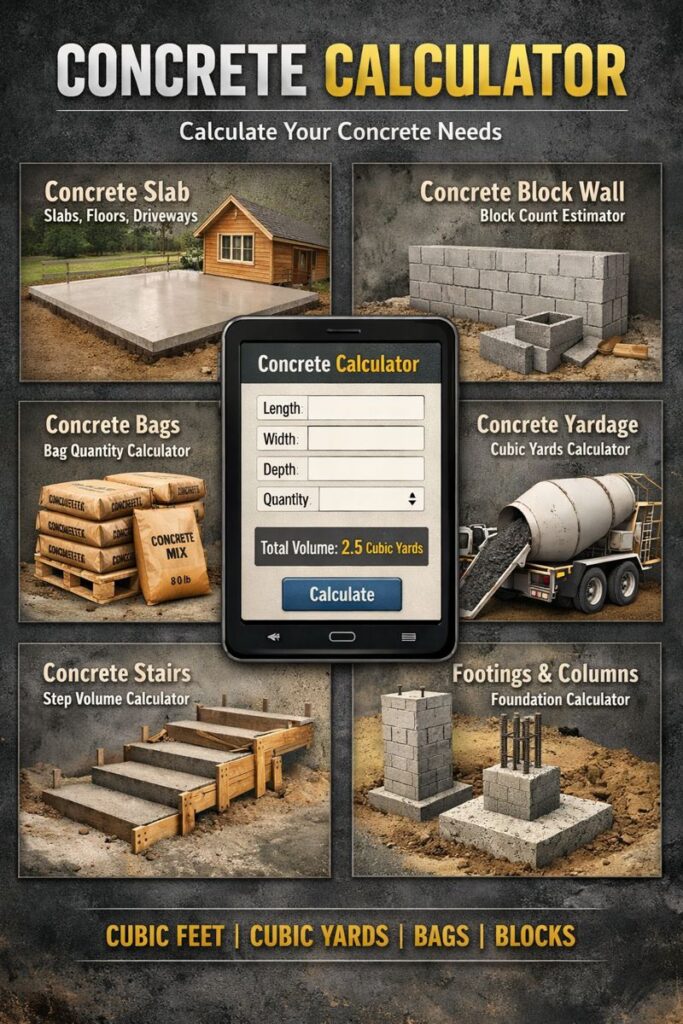
What Is a Concrete Calculator?
It is a tool used to calculate the volume of concrete required for a specific construction project. It converts project dimensions—length, width, depth, height, or thickness—into a measurable volume, typically expressed in:
- Cubic feet
- Cubic meters
- Cubic yards
Advanced concrete calculators also estimate:
- Number of concrete bags
- Total concrete yardage
- Material cost
- Waste allowance (overage)
These online calculators support multiple units such as feet, inches, meters, yards, and centimeters, making them useful worldwide.
Why Use a Concrete Calculator?
Concrete estimation errors are costly. Ordering too little concrete delays work, while ordering too much increases expense.
Using this calculator tool ensures:
- Accurate material estimation
- Reduced waste
- Better budgeting
- Faster planning
- Compliance with engineering standards
Professionals and DIY users rely on concrete calculators to prevent common mistakes in volume estimation.
How Concrete Volume Is Calculated
Concrete volume is calculated using basic geometric formulas, depending on the shape of the structure.
General Concrete Volume Formula
Volume = Length × Width × Thickness
This formula applies to:
- Slabs
- Driveways
- Floors
- Patios
- Foundations
The calculated volume is then converted into:
- Cubic yards (for ready-mix concrete orders)
- Concrete bags (for small projects)
Concrete Yard Calculator Explained
This calculator converts volume into cubic yards, which is the standard unit used by ready-mix suppliers.
Conversion Formula
1 cubic yard = 27 cubic feet
Example
If your calculated volume is 81 cubic feet:
81 ÷ 27 = 3 cubic yards
Concrete suppliers typically recommend adding 5–10% extra to account for spillage and surface irregularities.
Concrete Slab Calculator
A concrete slab calculator is one of the most frequently used tools. It calculates concrete required for flat surfaces such as:
- House foundations
- Garage floors
- Sidewalks
- Patios
- Driveways
Required Inputs
- Length
- Width
- Slab thickness
- Unit selection
Example
A slab measuring:
- Length: 20 feet
- Width: 10 feet
- Thickness: 4 inches (0.33 feet)
Volume = 20 × 10 × 0.33 = 66 cubic feet
Converted to yards:
66 ÷ 27 = 2.44 cubic yards
Concrete Bag Calculator
A concrete bag calculator estimates how many bags of pre-mixed concrete are required for a project. This is ideal for small-scale jobs such as:
- Fence posts
- Small slabs
- Garden features
- Repair work
Common Concrete Bag Sizes
- 40 lb bag → yields ~0.30 cubic feet
- 60 lb bag → yields ~0.45 cubic feet
- 80 lb bag → yields ~0.60 cubic feet
Example
If you need 6 cubic feet of concrete and use 80 lb bags:
6 ÷ 0.60 = 10 bags
Concrete Block Calculator
This calculator estimates the number of blocks required to build walls or partitions.
Standard Concrete Block Size
- 16 inches long × 8 inches high × 8 inches deep
Coverage Rule
- One block covers approximately 1.125 square feet
Example
For a wall measuring:
- Length: 20 feet
- Height: 8 feet
Area = 20 × 8 = 160 sq ft
Blocks required = 160 ÷ 1.125 ≈ 143 blocks
Always add 5–10% extra for breakage and cutting waste.
Concrete Volume Calculator for Complex Shapes
These Advanced concrete calculators support complex shapes such as:
- Footings
- Curbs and gutters
- Columns
- Beams
- Circular slabs
These calculators break structures into smaller rectangular or cylindrical volumes and sum them to calculate total concrete volume.
Concrete Calculator Units Explained
A professional calculator supports multiple unit systems:
| Unit | Usage |
|---|---|
| Feet & Inches | Residential construction |
| Meters | International projects |
| Yards | Ready-mix concrete orders |
| Centimeters | Architectural detailing |
Accurate unit conversion is critical. All dimensions must be converted to the same unit before calculating volume.
Concrete Calculator Accuracy and Best Practices
To get accurate results from a calculator:
- Measure dimensions precisely
- Use consistent units
- Include thickness accurately
- Add waste allowance (5–10%)
- Confirm shape selection
- Round up, never down
Professional contractors always order slightly more concrete than calculated.
Frequently Searched Concrete Calculator Questions
How much concrete do I need?
This depends on the shape and size of your project. A concrete calculator provides instant volume and yardage.
How many bags of concrete do I need?
Use a concrete bag calculator by entering total volume and bag size.
How do I calculate concrete for a slab?
Multiply length × width × thickness and convert to cubic yards.
How accurate are online concrete calculators?
High-quality calculators are accurate when correct measurements are entered and proper unit conversions are applied.
How many cubic yards of concrete are in a slab?
Divide total cubic feet by 27.
Concrete Calculator vs Manual Calculation
| Method | Accuracy | Speed | Risk |
|---|---|---|---|
| Manual Calculation | Medium | Slow | High |
| Concrete Calculator | High | Instant | Low |
These Digital concrete calculators reduce human error and improve project planning.
Who Should Use a Concrete Calculator?
It is valuable for:
- Contractors
- Civil engineers
- Builders
- Architects
- Homeowners
- DIY enthusiasts
- Landscapers
It is suitable for both small residential projects and large commercial construction.
Conclusion
This calculator is an indispensable tool for accurate construction planning. Whether you are estimating slab volume, determining bag counts, or planning block walls, the right calculator ensures precision, efficiency, and cost control.
For best results:
- Always measure carefully
- Use trusted calculators
- Add a safety margin
- Follow supplier recommendations
With accurate calculations, your concrete project starts on solid ground.
| Calculator Name | Access Tool |
|---|---|
| Age Calculator | Open Calculator |
| Zakat Calculator | Open Calculator |
| Chinese Gender Predictor | Open Calculator |