
Creatinine Clearance Calculator
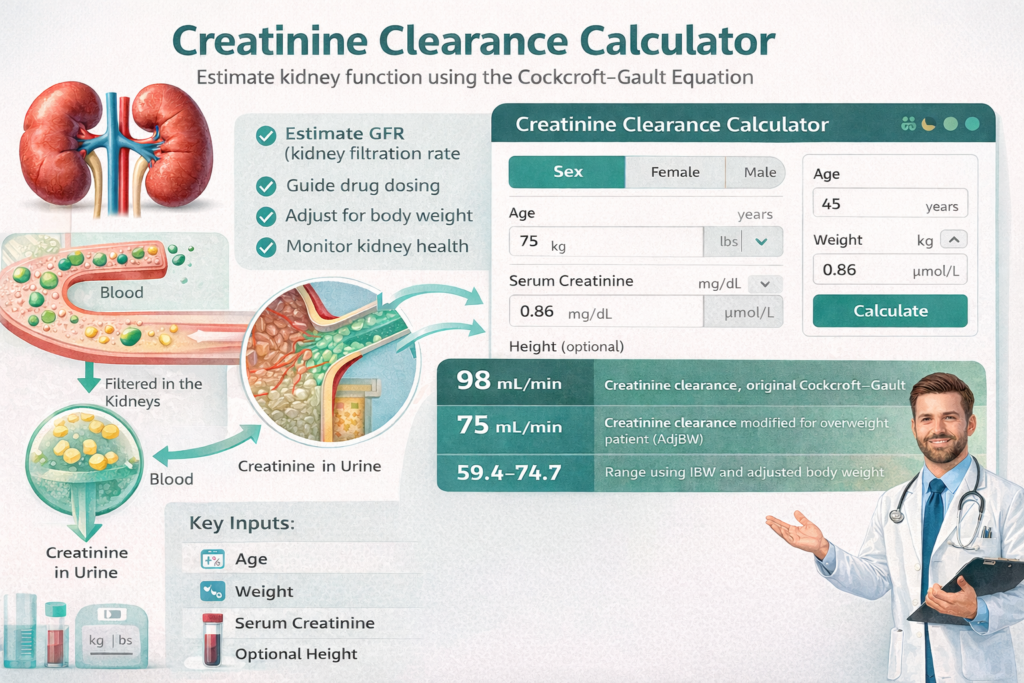
Creatinine Clearance Calculator: Accurate Assessment of Kidney Function
Introduction
The creatinine clearance calculator is a widely used clinical tool that helps estimate kidney function by measuring how effectively the kidneys remove creatinine from the blood. Creatinine is a metabolic waste product generated from normal muscle breakdown, and its clearance from the bloodstream reflects the filtering capacity of the kidneys.
Healthcare professionals frequently use creatinine clearance to evaluate renal function, adjust medication dosages, monitor chronic kidney disease (CKD), and assess patients before prescribing nephrotoxic drugs. With the help of a reliable clearance of creatinine calculator, clinicians and patients can quickly obtain standardized results without performing complex manual calculations.
This article provides a comprehensive medical overview of creatinine clearance, explains the formula creatinine clearance calculator uses, discusses clinical applications, limitations, interpretation of results, and answers the question how to calculate creatinine clearance accurately.
What Is Creatinine?
Creatinine is a waste product formed from the breakdown of creatine phosphate in skeletal muscle. It is produced at a relatively constant rate depending on muscle mass and is almost entirely eliminated from the body by the kidneys.
Key properties of creatinine:
- Freely filtered by the glomeruli
- Not significantly reabsorbed
- Slightly secreted by renal tubules
- Serum levels rise when kidney function declines
Because of these properties, creatinine is an excellent marker for estimating glomerular filtration and overall kidney performance.
What Is Creatinine Clearance?
Creatinine clearance (CrCl) refers to the volume of blood plasma that is cleared of creatinine per unit time, typically expressed in mL/min. It serves as an indirect measure of the glomerular filtration rate (GFR).
Although measured GFR is the gold standard for assessing kidney function, it is time-consuming and expensive. Therefore, creatinine clearance calculations remain a practical and widely accepted alternative.
Why Use a Creatinine Clearance Calculator?
Manually calculating creatinine clearance can be complex and prone to error, especially when unit conversions or body weight adjustments are required. A creatinine clearance calculator simplifies this process by:
- Reducing calculation errors
- Automatically converting units (mg/dL ↔ µmol/L, kg ↔ lbs)
- Applying sex-specific correction factors
- Adjusting for body weight and height
- Providing quick, clinically useful results
For both clinicians and patients, an online calculator ensures speed, consistency, and accuracy.
How to Calculate Creatinine Clearance
The Cockcroft–Gault Equation
The most commonly used method to calculate creatinine clearance is the Cockcroft–Gault equation, introduced in 1976. Despite newer equations, it remains essential for drug dosing and clinical decision-making.
Formula for Creatinine Clearance Calculator
Creatinine Clearance (mL/min) =
[(140 − age) × weight (kg)] ÷ [72 × serum creatinine (mg/dL)]

For females: multiply the result by 0.85
This equation estimates creatinine clearance based on:
- Age
- Body weight
- Serum creatinine
- Sex
Units Used in a Clearance of Creatinine Calculator
A professional clearance of creatinine calculator supports multiple unit systems to ensure global usability:
Weight
- Kilograms (kg)
- Pounds (lbs)
Serum Creatinine
- mg/dL
- µmol/L
(1 mg/dL = 88.4 µmol/L)
Height
- Inches
- Centimeters
Accurate unit conversion is critical, as even small errors can significantly affect results.
Role of Body Weight in Creatinine Clearance
Body weight plays a crucial role in creatinine clearance calculations. However, using actual body weight is not always appropriate, especially in overweight or obese patients.
Types of Body Weight Used
1. Actual Body Weight (ABW)
Used in patients with normal BMI.
2. Ideal Body Weight (IBW)
Calculated using height and sex:
- Male:
50 + 2.3 × (height in inches − 60) - Female:
45.5 + 2.3 × (height in inches − 60)
3. Adjusted Body Weight (AdjBW)
Used when actual body weight exceeds IBW significantly:
AdjBW = IBW + 0.4 × (Actual − IBW)
Modern creatinine clearance calculators often provide:
- Original Cockcroft–Gault result
- Adjusted result for overweight patients
- A range using IBW and AdjBW
Clinical Uses of Creatinine Clearance
1. Assessing Kidney Function
Creatinine clearance helps identify:
- Acute kidney injury (AKI)
- Chronic kidney disease (CKD)
- Progressive renal decline
2. Drug Dosing Adjustments
Many medications are eliminated by the kidneys. Creatinine clearance guides dose adjustments for drugs such as:
- Antibiotics (e.g., aminoglycosides, vancomycin)
- Anticoagulants
- Chemotherapy agents
- Antiepileptic drugs
3. Monitoring Disease Progression
Regular calculations allow clinicians to track renal function over time and adjust treatment plans accordingly.
4. Preoperative and Critical Care Assessment
Renal function assessment is essential before surgery or contrast imaging studies.
Interpretation of Creatinine Clearance Results
| Creatinine Clearance (mL/min) | Interpretation |
|---|---|
| ≥90 | Normal kidney function |
| 60–89 | Mild decrease |
| 30–59 | Moderate impairment |
| 15–29 | Severe impairment |
| <15 | Kidney failure |
Values must always be interpreted in the clinical context, considering age, muscle mass, hydration status, and underlying conditions.
Creatinine Clearance vs GFR
While both measure kidney function, they are not identical.
Creatinine Clearance
- Uses Cockcroft–Gault equation
- Depends on body weight
- Commonly used for drug dosing
Estimated GFR (eGFR)
- Uses MDRD or CKD-EPI equations
- Normalized to body surface area
- Preferred for CKD staging
Despite newer GFR equations, creatinine clearance remains the standard for many pharmacological decisions.
Limitations of Creatinine Clearance Calculations
Although useful, creatinine clearance calculators have limitations:
- Overestimation due to tubular secretion
- Reduced accuracy in:
- Elderly patients
- Extreme body sizes
- Liver disease
- Pregnancy
- Assumes stable kidney function
Therefore, results should always be correlated with clinical findings and laboratory data.
Factors Affecting Serum Creatinine
Several non-renal factors influence serum creatinine levels:
- Muscle mass
- Diet (high meat intake)
- Physical activity
- Certain medications (e.g., cimetidine, trimethoprim)
- Dehydration
These factors can impact the accuracy of creatinine clearance estimation.
Advantages of Using an Online Creatinine Clearance Calculator
- Eliminates manual errors
- Saves time in clinical settings
- Automatically applies correction factors
- Provides consistent results
- Enhances patient education
A well-designed calculator improves both clinical workflow and patient understanding.
Medical Disclaimer
The creatinine clearance calculator is intended for educational and informational purposes only. It does not replace professional medical advice, diagnosis, or treatment. Always consult a qualified healthcare provider before making medical decisions based on calculator results.
Frequently Asked Questions (FAQs)
Is creatinine clearance the same as kidney function?
It is an estimate of kidney function, specifically glomerular filtration capacity.
Can I calculate creatinine clearance at home?
Yes, using an online creatinine clearance calculator, but interpretation should be done by a healthcare professional.
Which formula is best for drug dosing?
The Cockcroft–Gault equation is still preferred for most medication dosing guidelines.
Does age affect creatinine clearance?
Yes, clearance naturally decreases with age due to reduced kidney function.
Conclusion
The creatinine clearance calculator is an essential medical tool for evaluating renal function, guiding medication dosing, and monitoring kidney health. By applying the proven formula for creatinine clearance calculator, healthcare professionals can efficiently calculate creatinine clearance and make informed clinical decisions.
Understanding how to calculate creatinine clearance, its clinical significance, and its limitations empowers both clinicians and patients to use this tool responsibly and effectively. When combined with professional medical judgment, creatinine clearance calculations play a vital role in modern patient care.
Popular Calculator Tools
- BSA Calculator
- Period Calculator
- Ovulation Calculator
- Blood Pressure Calculator
- Pregnancy Calculator
- Conception Calculator
- Due Date Calculator
- Pregnancy Weight Gain Calculator
- Pregnancy Conception Calculator
- Total Daily Energy Expenditure (TDEE) Calculator
- Blood Alcohol Concentration (BAC) Calculator
- Corrected Calcium Calculator
- eGFR Calculator
- Anion Gap Calculator
- BMI Calculator
- Calorie Calculator
- Body Fat Calculator
- BMR Calculator
- Ideal Weight Calculator
- Lean Body Mass Calculator