
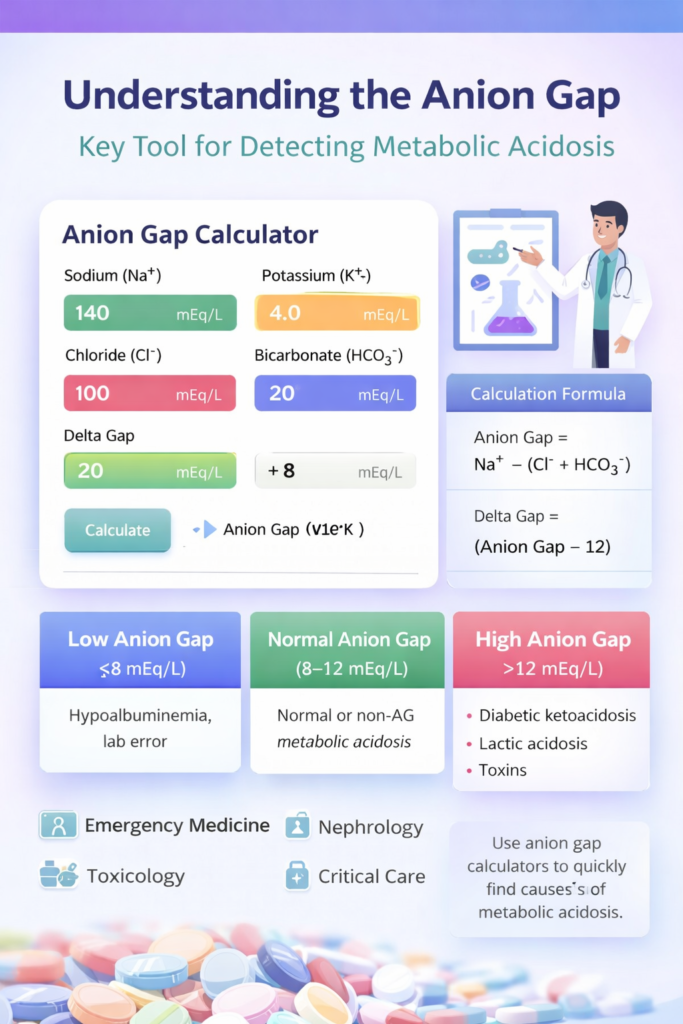
Anion Gap Calculator
mEq/L mEq/L mEq/L mEq/LAnion Gap Calculator: Complete Medical Guide to Anion Gap Calculation
The anion gap (AG) is one of the most important calculations in clinical medicine, particularly in the evaluation of acid–base disorders. An anion gap calculator helps clinicians quickly assess whether a patient has a metabolic acidosis and, if present, identify its likely causes. Understanding anion gap calculation, its formulas, interpretation, limitations, and clinical relevance is essential for accurate diagnosis and management.
This article provides a comprehensive medical explanation of the anion gap, how to calculate anion gap values, the physiology behind it, clinical applications, causes of abnormalities, delta gap interpretation, and evidence-based references.
What Is the Anion Gap?
The anion gap represents the difference between measured cations (positively charged ions) and measured anions (negatively charged ions) in the blood. It reflects the presence of unmeasured anions, such as organic acids, proteins, phosphates, and sulfates.
In routine laboratory testing, not all ions are directly measured. The anion gap helps estimate these unmeasured ions and plays a crucial role in identifying metabolic acidosis and its etiology.
Why Is it Important?
The anion gap is clinically important because it helps:
- Differentiate high anion gap metabolic acidosis from normal anion gap metabolic acidosis
- Narrow down life-threatening causes such as lactic acidosis, diabetic ketoacidosis, and toxic ingestions
- Guide urgent diagnostic and therapeutic decisions
- Monitor disease progression and response to treatment
Because of its importance, many clinicians rely on an anion gap calculator to avoid manual errors and ensure accurate interpretation.
Anion Gap Calculation Formula
Standard Anion Gap Calculation Formula (Without Potassium)
This is the most commonly used formula in clinical practice:
Anion Gap = Na⁺ − (Cl⁻ + HCO₃⁻)
Where:
- Na⁺ = Sodium (mEq/L)
- Cl⁻ = Chloride (mEq/L)
- HCO₃⁻ = Bicarbonate (mEq/L)
Anion Gap Calculation Formula (With Potassium)
Some clinicians include potassium:
Anion Gap = (Na⁺ + K⁺) − (Cl⁻ + HCO₃⁻)
However, because potassium concentration is relatively low and variable, many institutions prefer calculating anion gap without potassium.
Normal Anion Gap Values
| Calculation Type | Normal Range |
|---|---|
| Anion Gap (No K) | 8–12 mEq/L |
| Anion Gap (With K) | 12–16 mEq/L |
Normal ranges may vary slightly depending on laboratory methods and population.
How to Calculate Anion Gap Using an Anion Gap Calculator
An anion gap calculator simplifies the process by:
- Accepting laboratory values (Na⁺, Cl⁻, HCO₃⁻, optional K⁺)
- Automatically performing anion gap calculation
- Providing clinical interpretation
- Reducing calculation errors
- Saving time in emergency and critical care settings
Using an anion gap calculator is especially helpful in busy clinical environments such as emergency departments, ICUs, and internal medicine wards.
Physiological Basis of the Anion Gap
The body maintains electroneutrality, meaning total positive charges equal total negative charges. While labs measure some ions, others remain unmeasured.
Unmeasured Anions
- Albumin
- Phosphate
- Sulfate
- Organic acids (lactate, ketones)
Unmeasured Cations
- Calcium
- Magnesium
- Gamma globulins
An elevated anion gap indicates an increase in unmeasured anions, usually due to acid accumulation.
High Anion Gap Metabolic Acidosis
A high anion gap (>12 mEq/L) suggests the presence of excess acids in the blood.
Common Causes: MUDPILES Mnemonic
| Letter | Cause |
|---|---|
| M | Methanol |
| U | Uremia (renal failure) |
| D | Diabetic ketoacidosis |
| P | Propylene glycol / Paraldehyde |
| I | Isoniazid / Iron |
| L | Lactic acidosis |
| E | Ethylene glycol |
| S | Salicylates |
Clinical Significance
High anion gap metabolic acidosis is often life-threatening and requires immediate evaluation.
Normal Anion Gap Metabolic Acidosis
Also known as hyperchloremic metabolic acidosis, this occurs when bicarbonate loss is offset by chloride retention.
Common Causes
- Diarrhea
- Renal tubular acidosis
- Excess saline administration
- Early renal failure
An anion gap calculator helps distinguish this from high anion gap conditions.
Low Anion Gap: Causes and Clinical Relevance
A low anion gap (<8 mEq/L) is uncommon but clinically significant.
Causes
- Hypoalbuminemia (most common)
- Multiple myeloma
- Laboratory error
- Lithium intoxication
- Severe hypercalcemia or hypermagnesemia
Low anion gap values should prompt clinicians to review lab accuracy and albumin levels.
Albumin and Corrected Anion Gap
Albumin is the largest contributor to the normal anion gap. For every 1 g/dL decrease in albumin, the anion gap decreases by approximately 2.5 mEq/L.
Corrected Anion Gap Formula
Corrected AG = AG + 2.5 × (4 − albumin)
This correction is crucial in critically ill patients.
Delta Gap: Advanced Acid–Base Analysis
The delta gap evaluates mixed acid–base disorders.
Delta Gap Formula
Delta Gap = (Anion Gap − 12)
Interpretation
- Delta Gap ≈ change in HCO₃⁻ → pure high AG acidosis
- Delta Gap > HCO₃⁻ change → concurrent metabolic alkalosis
- Delta Gap < HCO₃⁻ change → additional normal AG acidosis
An anion gap calculator that includes delta gap adds significant diagnostic value.
Clinical Applications of Anion Gap Calculation
- Emergency medicine
- Critical care
- Nephrology
- Endocrinology
- Toxicology
- Internal medicine
Accurate anion gap calculation improves patient outcomes by enabling faster diagnosis and treatment.
Limitations
While extremely useful, the anion gap has limitations:
- Affected by albumin levels
- Varies between laboratories
- May be normal in early disease
- Cannot identify the exact acid
Therefore, it should always be interpreted in clinical context.
Medical Disclaimer
This anion gap calculator is intended for educational purposes only and should not replace professional medical judgment, diagnosis, or treatment.
Why Use this Calculator?
- Reduces manual errors
- Provides instant results
- Offers clinical interpretation
- Ideal for students and clinicians
- Improves workflow efficiency
References (Authentic Medical Sources)
- Kraut JA, Madias NE. Metabolic Acidosis: Pathophysiology, Diagnosis and Management. Nat Rev Nephrol. 2010.
- Oh MS, Carroll HJ. The Anion Gap. N Engl J Med. 1977;297:814–817.
- Emmett M, Narins RG. Clinical Use of the Anion Gap. Medicine (Baltimore). 1977.
- Adrogué HJ, Madias NE. Management of Life-Threatening Acid–Base Disorders. N Engl J Med. 1998.
- UpToDate: Approach to the adult with metabolic acidosis
- Harrison’s Principles of Internal Medicine, 21st Edition
Final Thoughts
The anion gap calculator is a powerful clinical tool that simplifies anion gap calculation and enhances diagnostic accuracy. When used correctly, it helps identify dangerous metabolic disturbances early, guiding timely intervention and improving patient outcomes.
Popular Calculator Tools
- BSA Calculator
- Period Calculator
- Ovulation Calculator
- Blood Pressure Calculator
- Pregnancy Calculator
- Conception Calculator
- Due Date Calculator
- Pregnancy Weight Gain Calculator
- Pregnancy Conception Calculator
- Total Daily Energy Expenditure (TDEE) Calculator
- Blood Alcohol Concentration (BAC) Calculator
- Corrected Calcium Calculator
- BMI Calculator
- Calorie Calculator
- Body Fat Calculator
- BMR Calculator
- Ideal Weight Calculator
- Lean Body Mass Calculator