
Body Surface Area Calculator
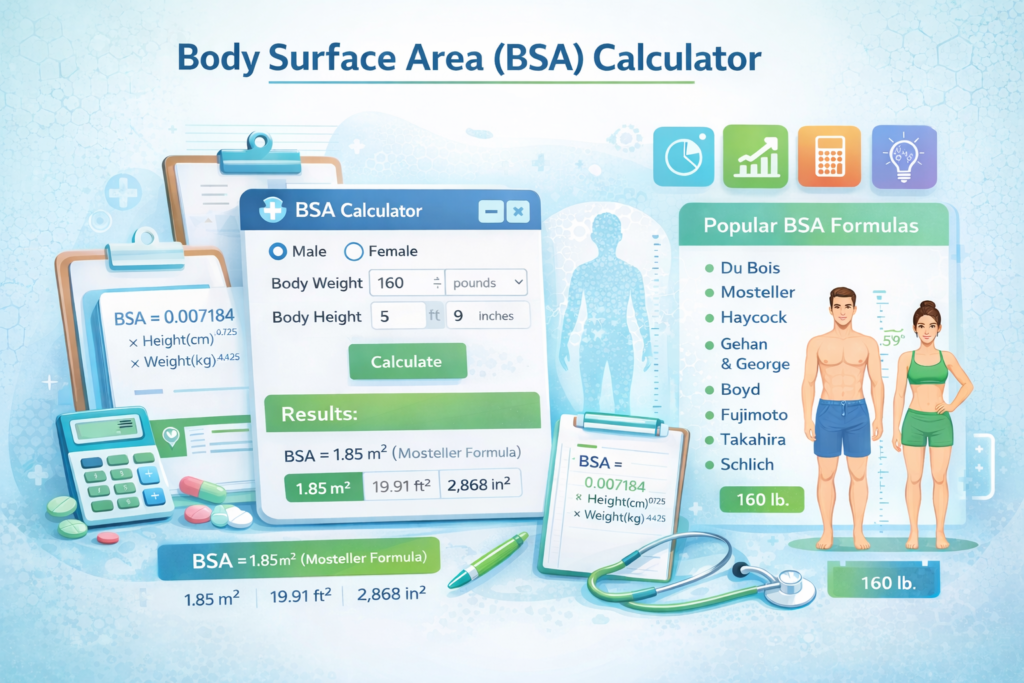
This calculator computes total body surface area (BSA) using popular medical formulas.
Body Surface Area (BSA) Calculator – Complete Guide
What Is Body Surface Area (BSA)?
Body Surface Area (BSA) is a medical measurement that represents the total external surface area of the human body, usually expressed in square meters (m²). It is widely used in healthcare because it provides a more accurate representation of a person’s metabolic mass than body weight alone.
Doctors and healthcare professionals rely on BSA to:
- Calculate drug dosages, especially chemotherapy medications
- Estimate fluid requirements
- Assess metabolic activity
- Evaluate burn severity
- Support clinical and nutritional assessments
A reliable body surface area calculator allows anyone to calculate BSA quickly and accurately without complex manual calculations.
Why Use a BSA Calculator?
Manual calculation for body surface area involves mathematical formulas and unit conversions that can be time-consuming and error-prone. A digital body area surface calculator simplifies the process by instantly applying validated medical formulas.
Benefits of using a BSA calculator include:
- Fast and accurate results
- Support for metric and U.S. units
- Multiple formula comparisons
- Reduced calculation errors
Whether you call it a surface area body calculator or a surface body area calculator, the purpose remains the same—accurate BSA estimation.
How to Calculate Body Surface Area
To understand how to calculate body surface area, only two values are required:
- Height (cm or ft/in)
- Weight (kg or lb)
These values are entered into one or more scientific equations developed through clinical research. Because body proportions vary among individuals, several formulas exist to improve accuracy.
An online calculate BSA tool automatically performs these calculations and presents the results in different units such as m², ft², and in².
Body Surface Area Calculation Formulas Explained
Below are the most commonly used formulas in a professional body surface area calculator.
1. Du Bois Formula
The Du Bois formula is one of the earliest and most historically significant methods for calculating body surface area. It was introduced in 1916 and remains a reference standard in many clinical settings.
Formula:
BSA (m²) = 0.007184 × Height(cm)^0.725 × Weight(kg)^0.425
Explanation:
- Uses exponential scaling for both height and weight
- Based on direct surface area measurements
- Forms the foundation for many later formulas
Best for:
- General medical use
- Historical comparison studies
Limitations:
May slightly overestimate BSA in obese individuals
2. Mosteller Formula (Most Popular)
The Mosteller formula is the most popular method used in modern clinical practice due to its simplicity and reliability. Many hospitals and medical calculators prefer this method.
Formula:
BSA (m²) = √[(Height(cm) × Weight(kg)) / 3600]
Explanation:
- Uses a square-root approach
- Easy to calculate manually and digitally
- Closely matches Du Bois results with less complexity
Best for:
Online BSA calculators
Routine clinical calculations
Drug dosage estimation
3. Haycock Formula
The Haycock formula was developed using data from infants, children, and adults, making it especially suitable for pediatric use.
Formula:
BSA (m²) = 0.024265 × Height(cm)^0.3964 × Weight(kg)^0.5378
Explanation:
- Balances height and weight more evenly
- Improves accuracy in children and adolescents
Best for:
Growth and development monitoring
Pediatric patients
4. Gehan and George Formula
The Gehan & George formula is based on metabolic mass analysis and was developed to improve accuracy across a wide range of body sizes.
Formula:
BSA (m²) = 0.0235 × Height(cm)^0.42246 × Weight(kg)^0.51456
Explanation:
- Derived from detailed metabolic studies
- Emphasizes proportional scaling
Best for:
Oncology dosage calculations
Research and clinical studies
5. Boyd Formula
The Boyd formula uses a logarithmic component to adjust for body mass variations, making it useful for individuals at extreme weight ranges.
Formula:
BSA (m²) = 0.0003207 × Height(cm)^0.3 × Weight(g)^(0.7285 − 0.0188 × log10(Weight(g)))
Explanation:
- Weight is used in grams
- Adjusts for obesity and low body weight
- More mathematically complex
Best for:
Advanced medical assessments
Obese or very lean individuals
6. Fujimoto Formula
The Fujimoto formula was developed using Japanese population data and is often used in East Asian clinical settings.
Formula:
BSA (m²) = 0.008883 × Height(cm)^0.663 × Weight(kg)^0.444
Explanation:
- Tailored to Asian body proportions
- Similar structure to Du Bois with population adjustments
Best for:
Regional clinical use
East Asian populations
7. Takahira Formula
The Takahira formula is a refined version of the Du Bois equation, developed to improve accuracy in specific populations.
Formula:
BSA (m²) = 0.007241 × Height(cm)^0.725 × Weight(kg)^0.425
Explanation:
- Slight coefficient adjustment from Du Bois
- Maintains similar scaling behavior
Best for:
Regional and comparative studies
8. Schlich Formula
The Schlich formula improves precision by accounting for gender differences in body composition.
Formulas:
For Men:
BSA (m²) = 0.000579479 × Height(cm)^1.24 × Weight(kg)^0.38
For Women:
BSA (m²) = 0.000975482 × Height(cm)^1.08 × Weight(kg)^0.46
Explanation:
- Gender-specific coefficients
- More accurate for adult populations
Best for:
High-precision clinical use
Adult male and female patients
A high-quality surface area body calculator displays results from multiple formulas to ensure accuracy and flexibility.
Average Body Surface Area by Age
The table below shows average BSA values by age group. These values are approximate and may vary depending on height and weight.
| Age Group | Average Height | Average Weight | Average BSA (m²) |
|---|---|---|---|
| Newborn | 50 cm | 3.5 kg | 0.23 |
| 1 Year | 75 cm | 10 kg | 0.47 |
| 5 Years | 110 cm | 18 kg | 0.78 |
| 10 Years | 140 cm | 32 kg | 1.15 |
| Teen (15 yrs) | 165 cm | 55 kg | 1.55 |
| Adult Female | 162 cm | 65 kg | 1.65 |
| Adult Male | 175 cm | 75 kg | 1.85 |
For precise results, always use a body surface area calculator rather than relying on averages.
BSA vs BMI – What’s the Difference?
BMI (Body Mass Index) estimates body fat based on height and weight, while BSA measures total body surface area.
- BMI is mainly used for population health screening
- BSA is preferred for medical dosing and treatment planning
This is why many clinical tools display both BMI and BSA together.
Who Should Use a BSA Calculator?
A BSA calculator is useful for:
- Doctors and nurses
- Pharmacists
- Dietitians and nutritionists
- Medical students
- Fitness and health professionals
- Patients managing long-term treatments
Anyone needing to calculate BSA accurately can benefit from an online tool.
Advantages of Online BSA Calculator
- Supports metric and U.S. units
- Instant results
- Clinically validated formulas
- Easy to use on mobile and desktop
Whether you search for a body area surface calculator or surface body area calculator, online tools ensure speed and accuracy.
Frequently Asked Questions
Is BSA more accurate than body weight for drug dosing?
Yes. BSA correlates better with metabolic activity, making it safer for medication dosing.
Which BSA formula is best?
The Mosteller formula is the most commonly accepted for routine use.
Can children use a BSA calculator?
Yes. Formulas like Haycock are designed specifically for pediatric patients.
Does gender affect BSA?
Indirectly. Gender-specific formulas like Schlich improve accuracy.
Final Thoughts
A body surface area calculator is an essential medical and health tool that provides accurate, reliable measurements for clinical and personal use. Understanding the principles behind calculation for body surface area helps users make informed health decisions.
Whether you want to learn how to calculate body surface area or simply need to calculate BSA instantly, a trusted surface area body calculator delivers precision every time.
Popular Calculator Tools
- Period Calculator
- Ovulation Calculator
- Blood Pressure Calculator
- Pregnancy Calculator
- Conception Calculator
- Due Date Calculator
- Pregnancy Weight Gain Calculator
- Pregnancy Conception Calculator
- Total Daily Energy Expenditure (TDEE) Calculator
- BMI Calculator
- Calorie Calculator
- Body Fat Calculator
- BMR Calculator
- Ideal Weight Calculator
- Lean Body Mass Calculator